
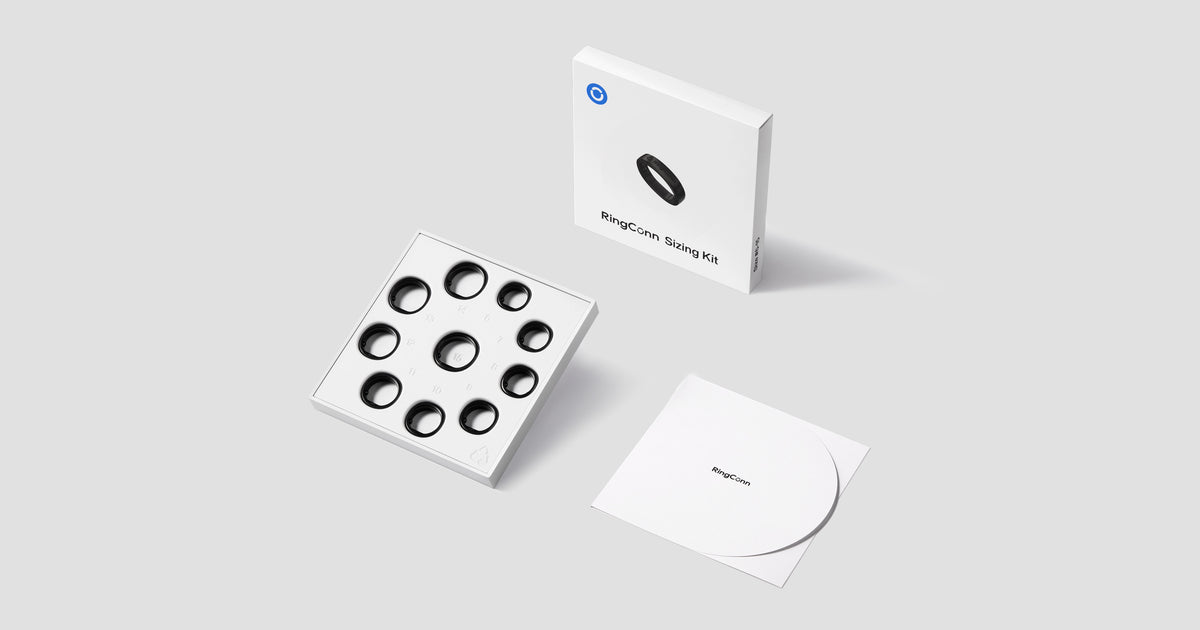
A smart ring is one of the few things you buy by picking a number before you have ever touched the product. That makes smart ring sizing kit vs guessing ring size a real decision rather than a formality, and RingConn puts it in front of you at checkout as two separate options. What follows is what each route actually produces, and why the number stamped inside a ring you already own helps less than it looks.
This is an independent editorial review. RingConn did not review or approve this article.
The federal guides quoted below describe how jewelry and precious metals may be described to shoppers. They are advisory rather than binding, they were not drafted with battery-powered rings in mind, and they appear here only to show which part of a ring somebody is expected to explain.
This article is about buying a device, not about health. A ring that estimates sleep or heart rate is not a diagnostic instrument, and the maker states on its own product page that the ring is not a medical device, so anything you notice in the data belongs with a clinician rather than with a buying guide.
Putting smart ring sizing kit vs guessing ring size in one table
The two routes are not two levels of care. They produce different kinds of number, and only one of them is the number the seller will build your ring against. Here is smart ring sizing kit vs guessing ring size laid out by what each step actually does.
| Point | Ordering the sizing kit | Guessing from a ring you own |
|---|---|---|
| What produces the number | A set of dummy rings made on the maker scale | A number from a jeweler, a chart or memory |
| Which scale it is on | The scale the ring is manufactured to | A trade scale the maker does not promise to match |
| When you commit | After wearing a test ring for a full day | At checkout, before anything arrives |
| What it costs | A wait before the ring ships | Nothing now, possibly an exchange later |
| Effect on the data | Fit is set for steady sensor contact | Seating is left to luck |
| Who it suits | Anyone buying their first sensor ring | Someone replacing a ring on the same scale |
The scale behind the number has no published rulebook
A ring size looks official. It is a small whole number, it appears on a chart, and a jeweler will read it off a steel gauge without hesitating. It is worth knowing how little of that is written down anywhere binding.
The closest thing the United States has to a rulebook for describing rings is the Federal Trade Commission guides at 16 CFR Part 23. Those guides apply to what they call industry products, and the list in section 23.0 is specific: “Gemstones and their laboratory-created and imitation substitutes; natural and cultured pearls and their imitations; and metallic watch bands not permanently attached to watches,” plus articles “fabricated from precious metals (gold, silver, and platinum group metals), precious metal alloys, and their imitations,” plus “all articles made from pewter.” A sensor housing in titanium and epoxy resin is none of those things.
Two more lines matter. Section 23.1 says it is “unfair or deceptive to misrepresent the type, kind, grade, quality, quantity, metallic content, size, weight, cut, color, character, treatment, substance, durability, serviceability, origin, price, value, preparation, production, manufacture, distribution, or any other material aspect of an industry product.” The word size sits in that list. Then the note under it asks for something the aisle almost never does: “If, in the sale or offering for sale of an industry product, any representation is made as to the grade assigned the product, the identity of the grading system used should be disclosed.” The guides also say of themselves that they “do not confer any rights on any person and do not operate to bind the FTC or the public.”
Read those together and the shape of the problem appears. The one document that asks a seller to name the scale behind a graded number was written for metal and stones, it is advice rather than law, and nothing in it reaches a device with a battery in it. So when two sellers print the number nine, nobody has promised you they mean the same circle.
Three rings, one size number, three different circumferences
This is not a theoretical gap, and the clearest evidence sits on the maker site. RingConn publishes one chart covering three products, and it tells you to “match your finger’s inner diameter or circumference with the appropriate RingConn size.” Read across a single row and the columns do not agree with each other.
- At size six, the Gen 3 column gives a circumference of 52.1 mm while the Gen 2 and Gen 2 Air columns give 51.6 mm.
- At size nine, Gen 3 gives 60.3 mm against 59.5 mm for the other two.
- At size twelve, Gen 3 gives 67.8 mm against 67.0 mm.
- The diameter column, meanwhile, prints the same figure for all three generations on every row.
A circumference and a diameter are two descriptions of one circle, so a chart that holds the diameter steady while moving the circumference is not describing one circle on that row. A ring 17.12 mm across measures a little under 54 mm around, which is neither of the printed figures. None of this is hidden and none of it is dishonest; it is a documentation gap on a page few shoppers read twice. It does mean the chart is a sanity check rather than an instrument.
The maker says as much in plainer words. The Gen 3 size guide opens by stating that “RingConn Gen 3 ring sizes differ from other RingConn rings, standard rings and other smart ring brands,” and the size selector on the product page repeats it before offering a free kit. The brand also keeps a standing answer to the question “Are Gen 3 ring sizes the same as previous generations?” on the same listing. When a seller writes that sentence three times in three places, it is not marketing. If you want the current lineup, RingConn lists the three generations side by side on its own product page.

Where the difference between smart ring sizing kit and guessing ring size actually shows up
Comfort is the obvious answer and it is the smaller one. The difference between smart ring sizing kit and guessing ring size lands hardest on the sensor, because a ring that rotates or slides is a sensor that keeps losing its seat.
The maker is direct about this. Its wearing guide tells you to “position the ring tracker (sensor side) against the pad of your index or middle finger,” which “ensures the ring is oriented correctly for accurate sizing and optimal sensor contact.” It recommends the index, middle or ring finger for testing rather than any finger you like, and it states that choosing the right size “helps ensure your RingConn smart ring provides accurate biometric data, consistent performance, and comfortable wear throughout the day.”
That is a different claim from a clothing size. A shirt that fits badly looks wrong; a ring that fits badly reports wrong. The kit exists because the maker has tied its own data quality to the fit, and a guessed number has no step at which that fit is ever tested.
You can see current options here:
Picking smart ring sizing kit or guessing ring size for beginners
For a first sensor ring there is not much of a contest, and the reason is mechanical rather than cautious. Choosing smart ring sizing kit or guessing ring size for beginners means choosing between a measurement taken on the maker scale and a measurement taken on somebody else scale, with no published bridge between them.
Guessing earns its place in two narrow cases. The first is a replacement of the same generation from the same maker, where the number you already submitted is the number that worked. The second is a gift, and the brand has built for that directly: its gift card is sold with a sizing kit included so the recipient can size themselves before redeeming, which is the same decision moved one step down the chain.
Everyone else is choosing between a short wait and an exchange. The sizing step is also where the brand parks its own awkward questions. The size page keeps standing answers to “Can I use a 3D printer instead of ordering the Sizing Kit?”, “Can I borrow a Sizing Kit from someone else?” and “What if I am between two sizes?” Three maintained answers to three ways of skipping the step tell you how often people try.
A smart ring sizing kit versus guessing ring size shortlist, step by step
If you want to work through it quickly, a smart ring sizing kit versus guessing ring size decision comes down to five checks in order.
- Check which generation you are buying, because the chart moves between them on the same size number.
- Decide the finger first. The maker recommends the index, middle or ring finger, and the sensor sits against the pad of that finger.
- If a kit is offered free at checkout, take it and accept the delay rather than ordering a size and hoping.
- Wear the test ring through a normal day and a night before submitting, not for ten minutes at the kitchen table.
- Submit the size through the account the order was placed under, which is where the maker expects to read it.
One practical note on shipping: the maker lists free shipping inside the United States and a three to five business day window after dispatch, with a one year warranty outside the EEA and two years inside it. The kit arrives first and the ring follows, so the wait is front-loaded rather than added on.
You can see current options here:
Related guides
- RingConn Smart Ring vs Smartwatch: What Each Measures
- Recovery Score Wearable vs Basic Fitness Tracker
- Wearable Metabolic Health Tracker vs Fitness Tracker
Frequently Asked Questions
The questions below come up on the size step rather than on the spec sheet, which is where the real uncertainty sits.
Ques: Can I use my jeweler ring size instead?
It is a starting point and not an answer. The maker states that its Gen 3 sizes differ from other RingConn rings, from standard rings and from other smart ring brands, and no published rule requires any seller to say which scale a size number belongs to.
Ques: Why does the size chart list a circumference and a diameter?
Both describe the same circle, and on this chart they do not reconcile row by row. Treat the chart as a way to rule sizes out rather than as a measuring tool, and use the physical kit to rule one in.
Ques: Does fit really change the readings?
The maker links the two directly, saying the right size helps ensure accurate biometric data and consistent performance, and it tells you to seat the sensor against the pad of the finger. A ring that rotates moves the sensor off that spot.
Ques: How long should I wear the test ring?
Long enough to cover a normal day and a night. The point of the test is to catch the hours when your hands are coldest or most swollen, which is exactly what a ten minute try-on misses.
Bottom line
The sizing kit is not a courtesy wrapped around a simple number; it is the only instrument that produces a number on the scale your ring will actually be made to. Guessing is reasonable only when you are repeating a size you have already proved on the same generation. For a first ring, take the kit and the wait.