

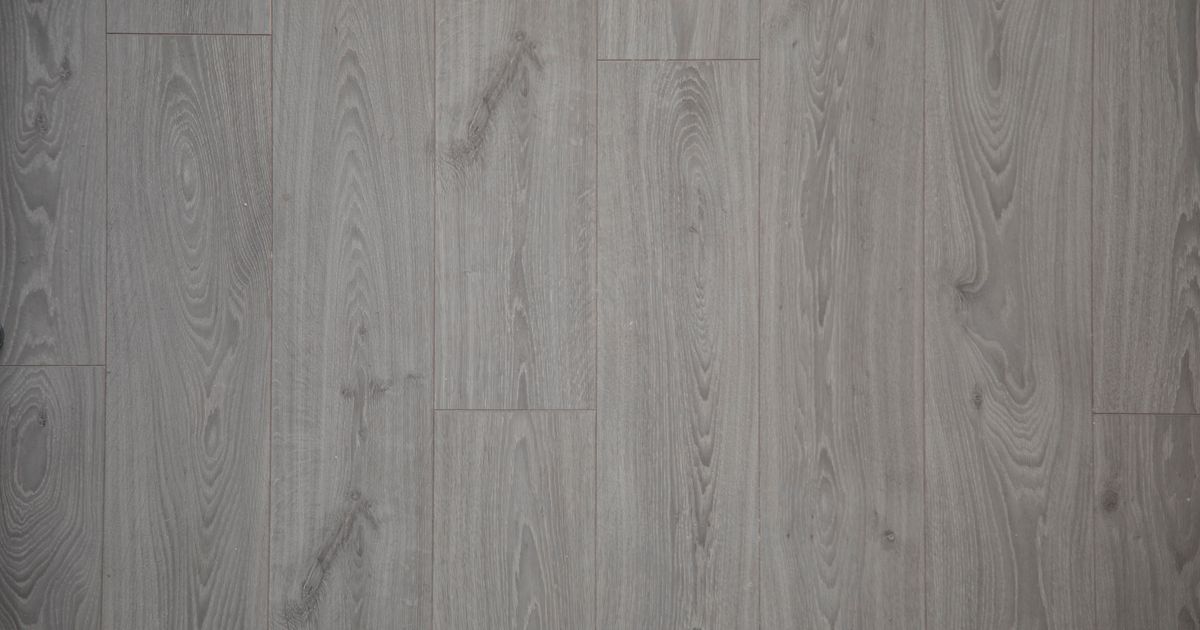
Two planks can look identical face up, click together the same way and carry the same printed oak grain, and still be made of completely different things under the surface. That difference decides which federal paperwork follows the box home. The laminate flooring vs vinyl flooring question is settled by what the core is, not by what the photograph on the sample board looks like.
This is an independent editorial review. Home Depot did not review or approve this article.
The federal rule quoted below is a labeling rule. It describes what a product built on a particular kind of panel has to say about itself, and it is not a durability grade, not a quality ranking and not a judgment on any floor. A product the rule does not reach has not been assessed and found wanting; it is simply outside the rule.
What laminate flooring vs vinyl flooring comes down to in one table
Strip away the showroom language and the two products differ on one structural fact, and everything else follows from it. A laminate plank is built on a wood-based panel. A vinyl plank is not built on wood at all. The retailer says the first half out loud: its own flooring hub sums laminate up as “Low-maintenance affordability with the look of real wood, tile or stone and a wood-based core for added strength.” The same hub sums vinyl up this way: “Provides an easy-to-install, waterproof, durable, stylish and affordable option.”
| What you are comparing | Laminate plank | Vinyl plank |
|---|---|---|
| What the core is | A wood-based panel | A plastic body with no wood panel |
| The decorative layer | A printed image under a clear wear coat | A printed image under a clear wear coat |
| Federal panel paperwork | Applies, because of the wood panel | Does not apply |
| The number the shelf sorts on | Not published as a filter in the listing seen | Wear layer, in mils |
| How water claims are worded | Offered as a feature called waterproof | Split into waterproof and water resistant |
| Who installs it | Either, depending on the locking system | Either, depending on the locking system |
The only label the aisle is required to carry sits on one of them
Because a laminate plank is built on a wood panel, it falls inside the Environmental Protection Agency’s formaldehyde rules for composite wood products. The definitions section of that rule, 40 CFR 770.3, defines a composite wood product as “hardwood plywood made with a veneer or composite core, medium-density fiberboard, and particleboard”, and defines a finished good as “any good or product, other than a panel” that contains one of those materials and is not a component part used in assembling something else.
The labeling section, 40 CFR 770.45, then says what has to be written down. Paragraph (c) is one sentence: “Fabricators of finished goods containing composite wood products must label every finished good they produce or every box or bundle containing finished goods.” Under (c)(2) that label “must include, at a minimum, in legible English text, the fabricator’s name, the date the finished good was produced (in month/year format), and a statement that the finished goods are TSCA Title VI compliant.” Paragraph (c)(3) allows an extra line where it is earned, so a maker may also state that the product was made “with no-added formaldehyde-based resins, or ultra low-emitting formaldehyde resins” where that is accurate. Paragraph (d) pushes the duty down the chain: “Importers, distributors, and retailers must leave intact labels on finished goods, including component parts sold separately to end users.”
There is a small-quantity escape in paragraph (e), and flooring is the textbook case of why it does not apply. It exempts a finished good whose regulated content “does not exceed 144 square inches, based on the surface area of its largest face”. Then it closes the door, stating that “The exception does not apply to finished goods or component parts that are designed to be used in combination or in multiples to create larger surfaces” and naming finished goods and component parts in the same breath. A floor is nothing but multiples creating a larger surface.
So the carton of laminate carries a name, a month and year, and a compliance statement. The carton of vinyl carries none of it, and that absence is not a failing grade. It is the rule reaching one material and not the other.
Sorting laminate flooring vs vinyl flooring pros and cons on the shelf
Here is the part a buying guide usually skips. The two products are merchandised in two different vocabularies, so the shelf itself cannot put them side by side. Reading the two categories at Home Depot on 7 November 2026, the vinyl plank category reported more than a thousand results under a long filter panel, and that panel leads with a numeric durability facet: “Wear Layer Thickness (mil)”, with selectable values of 1, 2, 3, 4 and 6 mil and more behind a show-more control. Alongside it sit “Product Thickness (mm)”, a “Water Protection” facet offering “Waterproof” and “Water Resistant” as separate choices, an “Installation Method” facet listing click lock, glue-down, peel and stick, adhesive and loose lay, and an “Installs Over Subfloor” facet.
The laminate category, as served on the same morning, published no numeric facet at all. Its navigation offered “Shop by Feature”, “Shop by Color”, “Shop by Style”, “Shop by Brand” and “Shop by Price”, with the feature values reading “Laminate Wood” and “Waterproof”. That is a genuine laminate flooring vs vinyl flooring pros and cons problem rather than a presentational quibble: one product can be filtered on a measured surface thickness and the other cannot be filtered on anything measurable.
Two more things follow from that read, and both are worth carrying into a store:
- The word waterproof appears on both sides. It is a feature value on the laminate navigation and a facet value on the vinyl panel, so it does not separate the two categories the way shoppers expect it to.
- Neither category offered any facet for emissions, certification, formaldehyde or indoor air quality. The one piece of mandatory paperwork in the aisle cannot be searched for, only read off the carton.
Where the filter panel answers is laminate flooring better than vinyl flooring
It does not, and that is the useful finding. A filter panel answers a narrower question: which variable the seller believes buyers rank on. For vinyl that variable is the thickness of the clear layer over the print, published in mils and sortable. For laminate the listing offers style and color and leaves the structural question to the product page. Anyone asking is laminate flooring better than vinyl flooring is asking a question the storefront has quietly declined to answer, because the two shelves are not scored on the same scale.
What a buyer can do instead is work the decision in a fixed order:
- Decide the room first. Standing water and a wood-based core are a poor match whatever the feature badge says, so a basement or a laundry room narrows the field before any spec does.
- On the vinyl side, read the mil figure and treat it as the wear number, because it is the only one the category lets you sort on.
- On the laminate side, ignore the color facets and go to the product page for the core and the thickness, which the category navigation does not expose.
- Check the installation facet against your subfloor, not against your confidence. Click lock, glue-down and loose lay are three different jobs.
- Read the carton label on the laminate before it leaves the store. Distributors and retailers are required to leave it intact, so it should be there.
What laminate flooring vs vinyl flooring 2026 listings still do not print
Three gaps survive even a careful read of both categories at Home Depot, and they are the same three on most big storefronts. First, no facet reports what happens at the plank edge, which is where a wood-based core meets standing water. Second, the vinyl panel sorts by wear layer but not by what sits under it, so two planks with the same mil figure can be built very differently. Third, a laminate flooring vs vinyl flooring 2026 listing almost never states the room the product is recommended for, which is the single thing that should come first.
None of that is hidden. It is simply not sortable, which is the modern version of hidden.
Check Best Deals on Home Depot
What to check on the carton before you buy
Five checks, in the order they actually matter:
- The room. Water exposure decides the material before any number does.
- The core description on the product page, not the category tile.
- The mil figure on vinyl, and the plank thickness on both.
- The installation method against your subfloor.
- The compliance label on a laminate carton, carrying a fabricator name, a month and year, and the compliance statement.
Related guides
- Solid Wood Furniture vs Particle Board: Plank+Beam
- Garden Cart vs Wheelbarrow: Two Capacity Numbers
- Outdoor Work Gloves vs Leather Work Gloves: Tractor Supply
Frequently Asked Questions
Shoppers land on the same four questions at the carton, and the first two are about paperwork rather than performance.
Ques: Why does only one of them carry a compliance label?
Because the federal rule attaches to composite wood panels. A laminate plank is built on one, so the finished good must be labeled with a fabricator name, a production month and year, and a compliance statement. A vinyl plank contains no such panel, so the rule does not reach it.
Ques: Does a missing label mean the vinyl is worse?
No. It means a different material is in the box. The label records compliance with one specific rule about one specific family of wood panels, and says nothing about wear, scratching or how long either floor lasts.
Ques: Can I compare the two on one number?
Not from the category pages as they were served. Vinyl is sortable by wear layer in mils and the laminate category published no equivalent numeric facet, so the comparison has to be made product page by product page.
Ques: Is waterproof a meaningful difference between them?
Less than it sounds. Both categories use the word, one as a feature value and one as a facet value, and the vinyl panel splits it into waterproof and water resistant. Read the specific wording on the listing rather than the badge.
You can see the current flooring range on the official site here:
Check Best Deals on Home Depot
Bottom line
The structural fact is the whole comparison: one plank is built on a wood panel and therefore arrives with a federally required label, and the other is not and therefore does not. Choose on the room and the core first, use the mil figure where the shelf offers it, and read the carton before it goes in the car.