
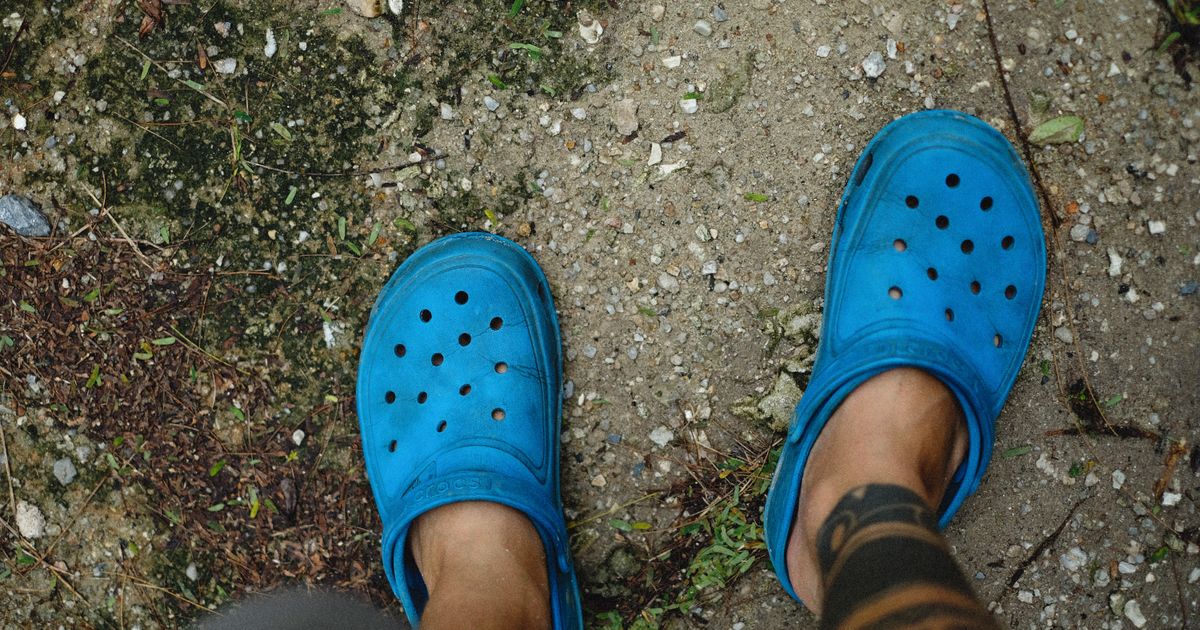
Both shoes are molded, both are open somewhere, and both get worn to the same places. Choosing between clogs vs sandals usually gets argued on looks, which is a shame, because there is one measurable thing separating them and it is the part nobody prints on a listing. That thing is how the shoe behaves when the ground is wet.
This is an independent editorial review. Crocs did not review or approve this article.
The safety guidance quoted below was written for employers buying footwear for work, not for shoppers. It makes no judgment about any shoe sold for ordinary wear and it carries no obligation for a brand or a buyer. It appears here because it is the only public source that says what a grip claim has to be backed by, and that makes it a good test of what a consumer listing leaves out.
What clogs vs sandals actually changes underfoot
| What you are comparing | A molded clog | An open sandal |
| How the foot is held | Enclosed toe, heel held by a strap that can be moved | Straps across the foot, heel usually free or buckled |
| Contact area with the ground | Full sole, usually one piece of resin | Full sole, often layered leather or resin |
| What the retail listing publishes | Material and care, no grip figure | Material and care, no grip figure |
| What changes when it rains | Water sits in the ports and drains | Water runs off the straps onto the footbed |
| What wears out first | The tread and the heel strap pivot | The strap fixings and the sole edge |
The one graded test for grip was written for work boots
Britain’s Health and Safety Executive publishes guidance for employers buying slip-resistant footwear, and its opening paragraph could have been written about a shoe shop. It says that choosing such footwear “from the whole host of products on the market can be difficult”, that “Sole descriptions are varied, from ‘improving the grip performance’ to ‘excellent multi-directional slip-resistance'”, and that “Often, footwear is just described as ‘slip-resistant’ and the brochure does not describe the conditions for which the footwear is most suitable.” Its instruction to buyers is direct: “do not select footwear on the basis of brochure descriptions or laboratory test results alone”.
Behind the marketing words there is a real grade. The guidance explains that where footwear has been tested, “coefficient of friction (CoF) test values must be available”, and that “The higher the CoF, the better the slip resistance.” Tested footwear carries one of three letter codes. SRA means it was “tested on ceramic tile wetted with dilute soap solution”, SRB means “tested on smooth steel with glycerol”, and SRC means it passed both. The guidance is honest about the limits of its own system, noting that “these test surfaces are not wholly representative of all underfoot surfaces”.
That grade exists only in occupational footwear standards. An everyday clog and an everyday sandal are sold without it, so the one attribute that separates them in use is the one attribute neither product page can quantify. The guidance also warns that “‘Oil-resistant’ does not mean ‘slip-resistant'”, because the first is only a statement that oil will not damage the sole. Hold that sentence next to a consumer claim and a pattern appears.
Reading clogs versus sandals against the sole and the strap
Looked at as clogs versus sandals, the brand’s own description of its material is a good example of a claim that sounds like grip and is not. Crocs states that all its shoes are made using a proprietary closed-cell resin called Croslite, which it says gives each pair “the soft, comfortable, lightweight and non-marking qualities” its wearers know. Non-marking is a claim about what the sole does to a floor, not about what the floor does to the wearer. It is accurate, it is useful if you have pale tiles, and it answers a different question from the one a wet pavement asks.
What the safety guidance says about construction does apply to both shoes, and it is checkable by eye. It states that “The sole tread pattern and sole compound are both important for slip resistance”, and that “Generally a softer sole and close-packed tread pattern work well with fluid contaminants and indoor environments. A more open pattern works better outdoors or with solid contaminants.” It also notes that “Slip resistance properties can change with wear”, and concludes that “The only sure way to tell is to trial footwear in your environment.” The UK storefront quoted above is run by Crocs itself.
The current range is listed here:
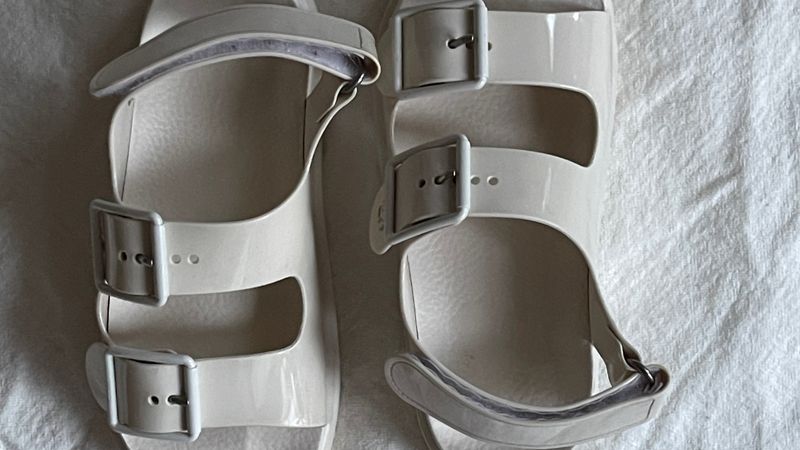
Where the difference between clogs and sandals shows up after the first wet step
The difference between clogs and sandals is mostly a question of how much of the foot is held, and that decides more than comfort.
- A clog holds the toe and the sides, so the foot cannot slide forward inside the shoe when you walk downhill.
- A sandal with a buckled heel strap holds the heel. A slide with no heel strap relies on your toes to keep it on.
- A heel strap that pivots gives you two shoes in one, which is convenient and means the grip you get depends on which mode you are in.
- Ports in a clog upper drain water downward. Straps shed it onto the footbed, which is the surface your foot is standing on.
- Both soles lose their edge as the tread wears, and neither product page tells you when that point arrives.
Two practical details from the brand sit alongside that. Its help pages ask owners not to expose the shoes to extreme heat or intense sunlight for an extended period, and they describe machine washing as being at the owner’s own risk, with a cool delicate cycle and a mesh bag suggested for lined models. Both are relevant, because heat deformation changes how a molded shoe sits on the foot.
Choosing clogs or sandals for beginners
Someone buying a first pair is really sizing a shape rather than picking a style, and clogs or sandals for beginners comes down to five checks.
- Decide where the shoe will mostly be worn, and be honest about how often that surface is wet.
- Pick the design that holds the heel if you walk any distance in them.
- Look at the tread with the shoe upside down, and prefer a close pattern indoors and an open one outdoors.
- Check the size system before ordering. The brand states that all sizes shown on its site are UK and EU sizes, while the sizes on the shoes and on the invoice are US sizes.
- Walk in them at home on the kind of floor you own, which is the consumer version of the trial the safety guidance recommends.
What to check on the listing before you buy
Expect a material name, a care instruction and a fit note, and expect no grip figure on either product. Read the returns window as the real trial period: the seller allows returns within 90 days with a receipt or proof of purchase, and the footwear warranty covers defects in materials and workmanship for 90 days from the date of receipt. That window, not the description, is where you find out which shoe suits your pavement. Note also who you are buying from. The UK site is operated by Crocs Europe B.V., a Netherlands company based at Planeetbaan 4 in Hoofddorp and registered with the Chamber of Commerce in Amsterdam, and it is a subsidiary of Crocs Inc. of Broomfield, Colorado. Its terms run under the law of the Netherlands rather than under UK law, and deliveries are accepted to the UK mainland.
Related guides
- Everyday Clogs vs Sneakers: What the Label Says
- Nike vs Adidas Trainers Compared
- Adidas Originals vs Performance Trainers
Frequently Asked Questions
Once grip becomes the deciding variable, the same queries keep returning.
Ques: Do everyday clogs or sandals carry a slip rating?
Ordinarily not. The letter codes exist in occupational footwear standards, so a shoe sold for general wear usually carries no code and no friction figure at all.
Ques: Does non-marking mean the sole grips well?
No. Non-marking describes what the sole leaves on a floor. The safety guidance makes the same point about oil-resistant soles, which only means oil will not damage them.
Ques: Which holds the foot better on a long walk?
The design that holds the heel. An enclosed clog with the strap down and a sandal with a buckled heel strap both do it; a backless slide does not.
Ques: Will the grip get worse over time?
Yes, and that is documented. The guidance states that slip resistance properties can change with wear, especially once the tread is worn down, so replacement is part of the cost.
The UK storefront is here:
Bottom line
Neither shoe publishes the one number that would settle the comparison, so the decision comes down to how much of your foot is held and what the sole looks like when you turn it over. Pick the shape that keeps your heel attached on the surfaces you actually walk on, treat the returns window as your own trial, and ignore any phrase on a listing that sounds like grip without naming a test.