


One route costs nothing, has no minimum and can be ready before you have finished your coffee. The other arrives at your door and charges by how awkward your basket is. The choice between click and collect vs home delivery is decided less by convenience than by one rule most shoppers never read: a single bulky item changes the price of everything else in the order.
This is an independent editorial review. DIY.com did not review or approve this article.
Every service, charge and exclusion described below is quoted from the customer-support pages of a British home-improvement retailer and applies in Britain. The place names, carve-outs and collection arrangements are that market’s own; no attempt is made here to map any of it onto another country’s retail practice.
A spec table for click and collect vs home delivery
The two routes are not a fast option and a slow one. They are priced on different things entirely.
| What you are comparing | Collection | Home delivery |
|---|---|---|
| Minimum order | None stated | One tier sets a minimum before you can use it |
| What sets the charge | Nothing; the service is free | The size and type of the items, in three tiers |
| Speed claim | Ready in as little as fifteen minutes | Next available date, or a date you pick |
| Who must be present | You, or a nominated person with the order number | Someone able to sign, in an all-day window |
| If plans change | Not collected inside the window, refunded automatically | The courier rearranges |
| Marketplace items | Selected products only, and slower | Arranged by the seller, not the retailer |
Three tiers, two thresholds, and the rule that moves you up
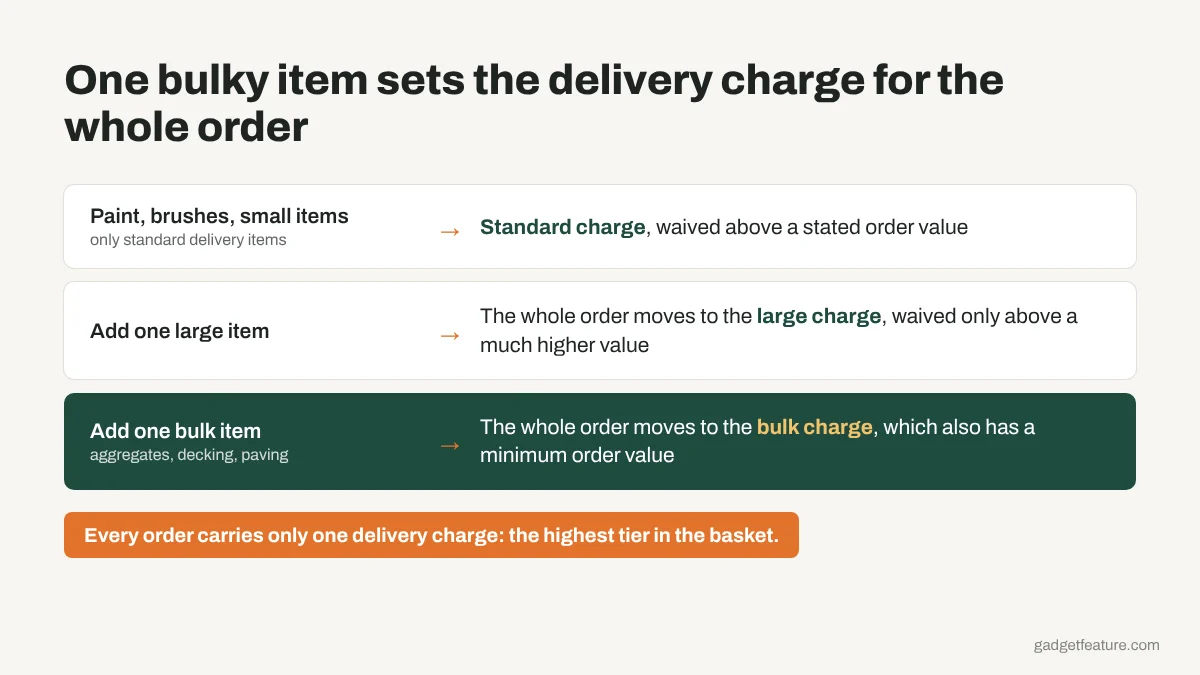
The delivery page at DIY.com sets out three services. Standard delivery carries a charge that is waived above a stated order value. Large delivery carries a higher charge, waived above a much higher order value. Bulk delivery, for things like aggregates, decking and paving, carries its own charge and a minimum order value, and is the only tier that is delivered by crane, between set morning and evening hours, with a text the night before and a call from the driver half an hour out.
So far that is an ordinary ladder. The rule that matters sits underneath it, and it is quoted in two sentences on the same page. If an order contains large delivery items as well as standard delivery items, the large charge applies. If it contains bulk delivery items as well as standard or large ones, the bulk charge applies. Then: “Your order will only have one delivery charge.”
Read that as a buyer and it changes the shopping, not the checkout. One bag of aggregate dropped into a basket of paint and brushes does not add a small handling fee to the bag. It reclassifies the whole order into the bulk tier and applies that tier’s charge once. The published thresholds that would have made standard delivery free no longer apply, because standard delivery is no longer the service you are using.
What the fifteen-minute claim is actually conditioned on
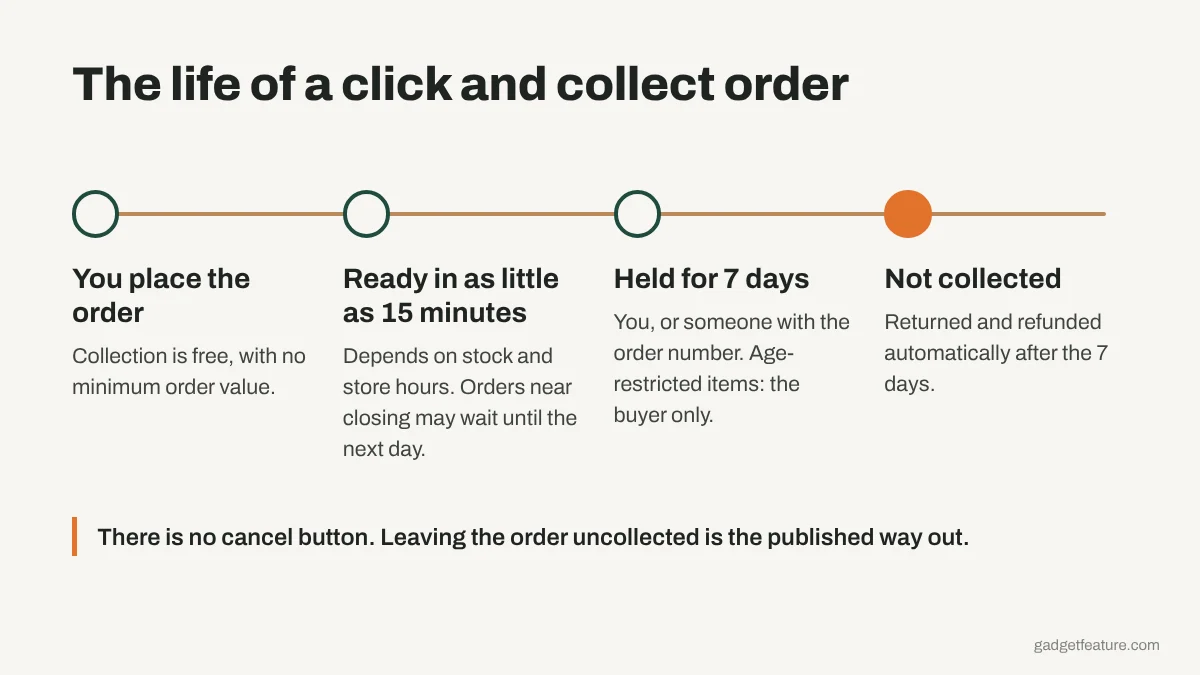
Collection is free, has no minimum order value, and the retailer says an order “could be ready in as little as 15 minutes.” The same pages attach three conditions to that, and all three are worth knowing before you drive anywhere. Readiness depends on “product availability and store opening hours.” An order placed within an hour of closing may not be ready until the following day. And the retailer tells you when it is ready rather than promising a slot.
The quieter condition is the one on the order rather than the store. Collection orders are held for seven days. Miss that window and the retailer says it will “automatically return it and process a refund.” On the same page it also says, of changing your mind, that it is “unable to cancel your order.” Those two sentences sit a paragraph apart and are not in conflict: there is no cancel button, and there is an expiry that produces the same outcome. If you no longer want a collection order, the published mechanism for undoing it is to leave it uncollected.

Reading click and collect versus home delivery on a single product page
The decision is not made once for your account. Run click and collect versus home delivery across a few listings in one category and the fulfillment flags move product by product. Paint listings read on 13 November 2026 carried three different combinations: available for home delivery and for free collection and in stores; available for free home delivery but “Not available for Click + Collect” and “Not available in stores”; and a paid home delivery line waived above a stated order value alongside collection “Available in selected stores.”
That makes availability a product specification rather than a service you switch on. A basket assembled on the assumption that everything can be collected can contain one line that cannot be, and the order then has to split or move wholesale to delivery.
- Check the fulfillment line on every listing, not on the first one you opened.
- Add the bulky item first if you are going to buy one, so you can see which tier the basket lands in.
- Bring the order number or the confirmation code, and remember that age-restricted items can only be collected by the person who ordered them.
- Treat seven days as the real deadline, because nothing else stops the order.
The difference between click and collect and home delivery once a marketplace seller is involved
The sharpest version of the difference between click and collect and home delivery appears on orders that are not fulfilled by the retailer at all. Products shown as sold and shipped by a verified seller are carved out of both services in different ways. For delivery, “the seller will arrange delivery directly with you,” and if something goes wrong you are pointed at a contact-seller option in your account or your confirmation email rather than at the retailer’s own support.
For collection the carve-out is narrower and more specific. Only selected products from selected sellers can be collected at all, collection is arranged by the seller, it is “not eligible for 15-minute or same day click and collect,” and it is not available in Northern Ireland. Estimated collection times run from the next working day for orders received by midday. The service keeps its name and loses the thing that makes it worth using.
Running click and collect or home delivery for beginners, in order
For a first order, click and collect or home delivery for beginners comes down to four checks, done in this sequence.
- Decide whether anything in the basket is heavy, long or loose, because that sets the tier.
- Read the fulfillment line on each listing rather than assuming it matches the others.
- Check who is selling the item, since a marketplace seller changes both routes.
- If collecting, work out who can realistically go within seven days.
Bulk delivery also carries a geographic exclusion list, naming the Scottish islands, the Isles of Scilly, Jersey, Guernsey and forces postal addresses. Collection has its own geography: a separate collection service operates from marked vehicles in a supermarket chain’s car parks at five named sites, with an evening order cut-off and a midday pick-up the next day.
Related guides
- Storage Bins vs Built In Storage
- Restaurant Delivery vs Grocery Delivery
- Laminate Flooring vs Vinyl Flooring
Frequently Asked Questions
Four questions decide this before the basket is full.
Ques: Is collection always free?
On this retailer, yes, and with no minimum order value. The cost sits elsewhere: your time, and the seven-day window in which somebody has to appear.
Ques: Will one heavy item really change the whole delivery charge?
Yes. The published rule applies the highest tier present to the entire order, and states that an order carries only one delivery charge. Add the bulky item first and watch which tier the basket lands in.
Ques: Can somebody else collect for me?
Generally yes, with the order confirmation or order number. The exception is age-restricted goods, which the retailer says can only be collected by the person who placed the order.
Ques: What happens to an order I never collect?
After seven days it is returned and refunded automatically. That is also the only published route to undoing a collection order, since the retailer says it cannot cancel one.
Both services are set out on the storefront itself.
Bottom line
Collection wins on price and loses on logistics; delivery wins on effort and is priced by the single most awkward thing you bought. Decide the tier before you decide the route, read the fulfillment line on each listing, and check who is actually selling the item, because a marketplace seller quietly changes both answers.




2 Comments
Comments are closed.