
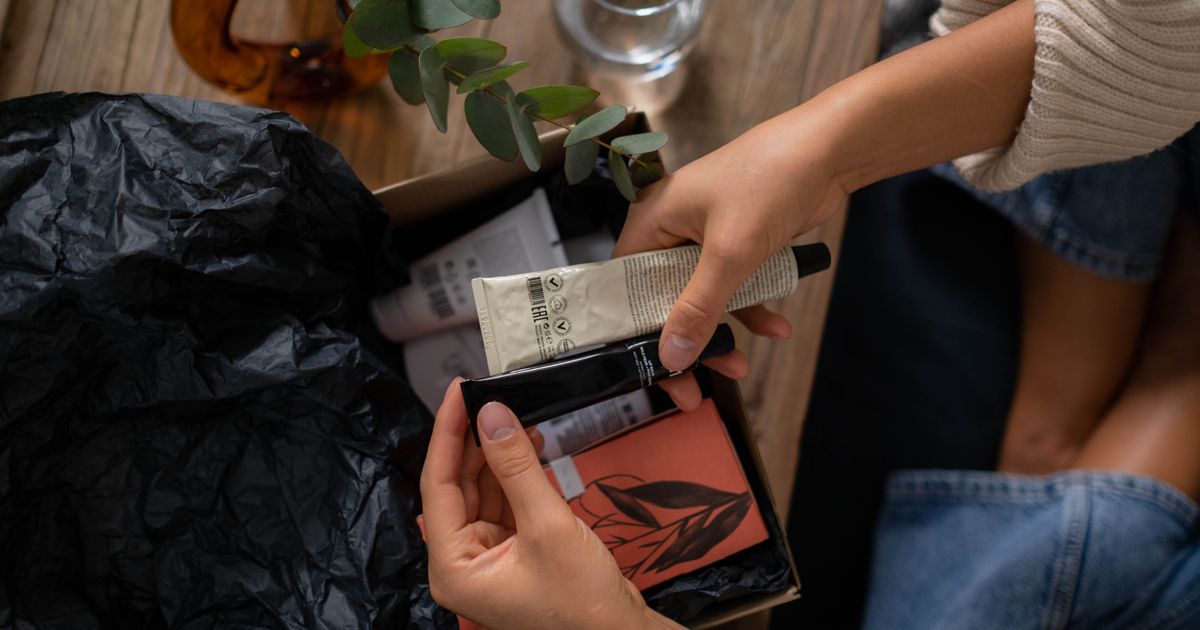
A monthly box and a shelf of full size bottles look like two ways of buying the same thing, and they are not. The beauty box subscription vs buying full size products decision is settled by one number, and that number is missing from one side of it on purpose.
This is an independent editorial review. GlossyBox did not review or approve this article.
The labeling rule quoted below is the retained European cosmetics regulation as it applies in the United Kingdom, which is the market this article is written for. It governs what a container has to print, not whether any product works, and prices and box contents here change every month.
Comparing beauty box subscription vs buying full size products
Both routes put cosmetics in your bathroom. They publish completely different information about what you are getting, and the table below is a map of that gap rather than a scorecard.
| What you are comparing | Monthly box | Full size purchase |
|---|---|---|
| Quantity you can read before buying | A size word, not a measure | A measure on the container |
| Who picks the products | The seller, one theme per month | You, one product at a time |
| Published value | A worth figure per item | A shelf price per item |
| Shelf life you can plan around | Unknown until the jar arrives | Printed on the pack in store |
| How the commitment ends | A monthly calendar date | When you stop rebuying |
| What repeats | The box, not the product | The product, when you want it |
The labeling rule that runs out at five grams
Cosmetics sold in the United Kingdom carry a short list of compulsory information. The regulation says they may be made available “only where the container and packaging of cosmetic products bear the following information in indelible, easily legible and visible lettering”, and the second item on that list is the one a shopper actually needs: “the nominal content at the time of packaging, given by weight or by volume”.
Then comes the clause that decides this comparison. The quantity requirement applies “except in the case of packaging containing less than five grams or five millilitres, free samples and single-application packs”. Three exemptions, and a subscription box is built almost entirely out of all three.
The durability rule bends the same way. A product that keeps for a long time does not need a date at all, because “indication of the date of minimum durability shall not be mandatory for cosmetic products with a minimum durability of more than 30 months”. In its place there is a period-after-opening mark, which tells you how long the jar lasts once you start it rather than how long it has been sitting in a warehouse.
What a beauty box subscription vs buying full size products comparison can actually sort
Read a box listing and you will find that a beauty box subscription vs buying full size products comparison is being offered to you in the wrong unit. The GlossyBox monthly listing names five products and tags each one as either a full size item or a deluxe size item, with a separate worth figure beside every line. That is a value claim and a category word. Neither is a volume.
Deluxe size is the interesting one, because it appears nowhere in the regulation. It is a merchandising word that sits between a sachet and a retail bottle, and it is doing the heaviest lifting on the page. The rule that would force an actual figure onto the jar is the same rule that exempts jars of that size.
- A full size line means the product you would buy in a shop, and you can look its volume up elsewhere.
- A deluxe size line means a smaller version of a retail product, with no published measure.
- A worth figure is the seller’s estimate of value, not a quantity.
- Five items is a count, and a count is the one number both routes agree on.
The brand is not hiding anything here. Its own product page tells you to go to the jar: “For the latest information, it is recommended to review the ingredient list printed on the packaging of the product prior to usage or consumption.” That is the right instruction, and it only works once the box has arrived.
You can see the current month’s five items and their size tags on GlossyBox, which publishes the list before you subscribe.
You can look at the current plan here:
Asking beauty box subscription or buying full size products which is better
Put like that the question has no answer, because the two routes are not trying to do the same job. Anyone asking beauty box subscription or buying full size products which is better is really asking which failure they would rather absorb: paying for a product you never use, or buying a full bottle of something that turns out not to suit you.
The box is a discovery mechanism. It is efficient at the first of those failures and useless against the second, because a deluxe size jar will run out before you know whether the product earned a permanent place. Buying full size is the reverse. It settles the question properly and costs more when the answer is no.
Where a beauty box subscription vs buying full size products review usually stops
A beauty box subscription vs buying full size products review almost always stops at the contents of one month, which is the part that changes. The part that does not change is the calendar, and it is written down.
GlossyBox runs the subscription on a fixed monthly date rather than on a rolling clock from the day you joined. Its help pages state that you must cancel by the fourteenth of the month if you do not want further boxes, and that a cancellation made after that still produces one more edition, because the box has already been allocated. Orders already in progress cannot be stopped at all.
There is a separate statutory right to cancel, and it sits oddly next to the product. The returns policy says: “You have the right to cancel this contract within 14 days of receiving your first box without giving reason.” The same page then sets the condition: “Please ensure that the items you are returning are unopened and in any original packaging”, with “any retail seals unbroken”. A box of trial sizes exists to be opened, so the two-week right and the thing you bought the box for do not overlap for long. That is not a trick, it is the ordinary distance between a distance selling rule and a sampling product, and it is worth knowing before the parcel lands.
One more clock sits behind both: missing or damaged items have to be raised within sixty days of receiving the merchandise.
What the listing can tell you before you subscribe
- Count the lines tagged full size against the lines tagged deluxe size. That ratio is the real spec.
- Look for a volume anywhere on the page. If there is none, the exemption above is why.
- Note the monthly cutoff date, not the date you joined.
- Check which plan length you are agreeing to, because the upfront plans renew at the end of the term.
- Decide in advance which one product you are hoping to find, so a miss is cheap and a hit is obvious.
Two of those five are about the calendar rather than the cosmetics, which is a fair reflection of where subscription money actually goes wrong.
Related guides
- Perfume Discovery Set vs Full Size Perfume: Add It Up
- Skincare Gift Set vs Individual Skincare Products
- Fragrance Tester vs Retail Bottle
Frequently Asked Questions
These four come up more than any others once the labeling exemption is visible.
Ques: Does a deluxe size product have a standard volume?
No. It is a seller’s category rather than a defined measure, and the regulation that would require a figure exempts packaging under five grams or five milliliters, and it exempts free samples and single-application packs too.
Ques: Will the box tell me how long a product keeps?
Not before it arrives. A cosmetic that keeps for more than thirty months needs no minimum durability date, only a period-after-opening mark, and that mark is on the jar rather than on the listing.
Ques: Can I cancel after the first box and keep it?
The statutory right runs for fourteen days from receiving the first box, and the returns conditions ask for unopened goods with seals unbroken, so returning a box you have sampled is not the route. Ending the subscription on the monthly cutoff date is.
Ques: Is a box cheaper than buying the same products outright?
That is unanswerable from the listing, because the worth figures are value estimates and the quantities are not published. A box is reliably cheaper per trial and not reliably cheaper per milliliter.
This month’s five items and their size tags are listed here:
Bottom line
A subscription buys you trials and a calendar; buying full size buys you a known quantity and no calendar. The listing can only tell you the first of those, because the rule that would print the second has an exemption written for exactly the jars a box is made of.