

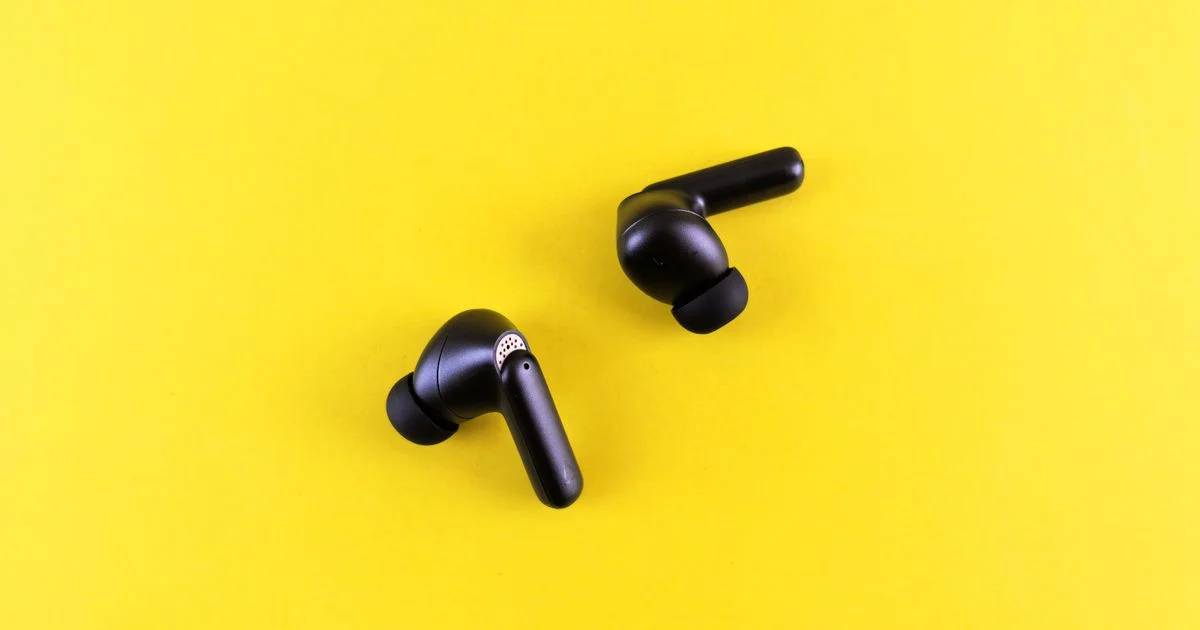
Every listing leads with a decibel number, and almost every one of them is a single best-case point on a lab curve. Once you know what that figure is measuring, the rest of the spec sheet on noise cancelling earbuds for commuting gets much easier to read — and much less impressive.
Key Takeaways
- Advertised dB figures are peak lab numbers. Independent testing of budget models typically finds 18 to 26 dB of real reduction against a 45 dB claim.
- ANC works on steady low-frequency sound, roughly 20 Hz to 1 kHz. Above that, your ear tips are doing the work, not the electronics.
- Hybrid means two mics per bud — one outside, one inside. It is now standard at mid-range and is worth insisting on.
- Headline battery hours are often mono-mode or case-included totals. The number you care about is stereo playback per charge with ANC on.
- A bad seal undoes good ANC completely. Ear tip fit matters more than the chipset.
What the specs on noise cancelling earbuds for commuting really tell you
The short answer: three specs decide the experience — how many mics each bud has, how well the tips seal your ear canal, and how many stereo hours you get with ANC switched on. Everything else on the box is decoration. Good noise cancelling earbuds for commuting are the ones that hold a seal on a moving train and cut the drone underneath the announcements, and neither of those things is captured by a decibel headline.
ANC itself is simple enough. A microphone hears the noise around you, a chip works out the exact opposite of that sound wave, and the driver plays it back so the two cancel in your ear canal. Where it gets interesting is what that process can and cannot keep up with.
The dB number is one point on a curve
A “45 dB” claim is not a promise that the world gets 45 dB quieter. It is usually the single best point on the attenuation curve, measured in a lab against a steady test tone at the frequency the system handles best. One 2026 round of testing found seven models missing their advertised figure by more than 5 dB, and independent measurement of budget earbuds generally lands in the 18 to 26 dB range in real conditions — a long way from the sticker.
The gap widens as noise becomes less steady and more varied in frequency. On a subway platform with a train arriving, an announcement running and a conversation two feet away, you are far from the lab tone the number was measured against.
What matters more is even attenuation across the range. A model that cuts 25 dB consistently from 50 Hz to 800 Hz will feel dramatically quieter on a commute than one that spikes to 40 dB at 100 Hz and collapses either side of it. Manufacturers rarely publish the curve, so the practical move is to weigh independent measurements over the box figure and ignore percentage claims entirely — “98.5% noise reduction” is an engineering measurement under specific conditions, not a prediction of how loud the world will sound.
Why voices survive
ANC’s useful range is roughly 20 Hz to 1,000 Hz. Above that, the wavelengths get short enough that the anti-noise signal arrives late — the distance between mic, chip and driver becomes significant. Speech is also unpredictable: pitch and volume shift constantly, so there is no steady pattern to lock onto. That is why engine rumble vanishes and the person on the phone behind you does not.

Feedforward, feedback and hybrid: what the mic count buys you
Listings throw these words around without explaining them, and they describe genuinely different hardware.
- Feedforward: a microphone on the outside of the bud catches noise before it reaches your ear. Fast, but it is guessing at what will actually arrive at your eardrum, so it is less accurate — and it is the arrangement most exposed to wind.
- Feedback: a microphone inside the bud measures what genuinely reached your ear and corrects for it. More accurate, but a system listening to its own output can become unstable.
- Hybrid: both, working together. This is now standard on mid-range earbuds and increasingly on cheap ones, because dual-mic MEMS packages have fallen below fifty cents a unit.
Hybrid on a budget model is not the same as hybrid on a flagship. The microphones may be similar; the algorithm doing the cancellation is not. Budget hybrid implementations are strong on steady low-frequency suppression and limited on conversation and wind — which, for a commute, is the trade you would choose anyway.
Best ANC earbuds for train commute duty: match the spec to the noise
Deciding on the best ANC earbuds for train commute use means being honest about what a train sounds like. The dominant component is low-frequency: motor drone, rail rumble, ventilation. That is precisely the band ANC handles best, which is why commuting is the single strongest use case for the technology.
What ANC will not do on a train is remove announcements, door chimes, or the conversation across the aisle. Those sit above the cancellation range and are handled — or not — by the physical seal of your ear tips. That is why the fit test matters more than the chip.
- Try every tip size in the box, including the ones you assume are wrong.
- Put them in, play nothing, and listen. A good seal makes the room noticeably duller before ANC is even on.
- Turn ANC on and off with music paused. The difference should be obvious and low-pitched.
- Chew, talk and walk. If the seal breaks, bass and cancellation both collapse at once.
- Consider foam tips. Some models ship them, and on those the difference in measured performance is large.
One more commuting-specific note: maximum ANC is not always the right setting. Crossing a road or navigating a platform, transparency mode or a reduced setting is the safer choice, and having a usable transparency mode is worth more on a commute than a couple of extra decibels.
Noise cancelling earbuds long battery life claims, decoded
Battery specs are where the marketing gets most creative. A pair advertising noise cancelling earbuds long battery life at 90 hours is almost certainly quoting mono mode — alternating one bud at a time while the other charges — which nobody actually does. The same product’s honest stereo figure might be 8 hours per charge with roughly five more charges in the case, for about 48 hours of real listening.
Three numbers hide inside every battery claim, and only one of them is yours:
- Buds-only playback: how long a single charge lasts. This is the number that decides whether you make it through a week of commutes without opening the case at your desk.
- Total with case: buds plus every case recharge added together. Useful for trips, misleading as a headline.
- Mono or ANC-off figures: quoted when the honest number is unflattering. Always check whether ANC was on.
Modern ANC is far less costly to battery than it used to be — current mid-range models manage something like six and a half hours of playback with ANC enabled and close to 28 hours including the case. Look for the buds-only, stereo, ANC-on figure, and treat anything else as advertising.
Commuter earbuds comparison by tier
This commuter earbuds comparison stays qualitative on purpose — street prices move constantly, but what each tier gets you has been stable for a while.
| Tier | ANC hardware | What a commute feels like | The catch |
|---|---|---|---|
| Entry | Feedforward only, one mic per bud, few tip sizes | Some reduction in engine drone; announcements and voices unchanged | Wind noise is intrusive; ANC can add a faint hiss; seal is hit or miss |
| Mid | Hybrid dual mics, simpler algorithm, several tip sizes | Train and bus rumble largely gone; speech still audible | Struggles with varied noise; transparency mode often sounds processed |
| Upper | Hybrid with adaptive tuning, fit detection, foam tip options | Even cancellation across the low band; usable transparency for platforms | Costs considerably more for a difference measured in single-digit decibels |
What to check before you buy
- Confirm the earbuds are hybrid — two microphones per bud, not one.
- Find the buds-only stereo playback figure with ANC on, not the case total.
- Count the included tip sizes, and check whether foam tips are an option.
- Check that transparency mode exists and can be triggered without the phone.
- Look for independent measurement of the ANC curve rather than the box’s peak dB.
- Check the fit-detection or seal-test feature if you have trouble getting tips to hold.
- If you cycle or walk in wind, read specifically about wind handling — feedforward mics suffer most.
If you are buying for flights as much as trains, our guide to small travel gadgets covers what else earns bag space.
Frequently Asked Questions
The same handful of questions comes up whenever someone starts comparing ANC specs, and most have short, unglamorous answers.
Is 45 dB of noise cancelling twice as good as 25 dB?
No, and often the two products perform similarly. The larger number is usually a peak measured under favorable lab conditions. Even attenuation across the low-frequency band matters far more than the height of a single spike.
Why can I still hear people talking?
Because speech sits above the range ANC can act on, and because voices are unpredictable enough that the system has no steady pattern to cancel. Blocking speech is the ear tip’s job, which is why fit matters so much.
Does ANC drain the battery badly?
Not the way it used to. Current models lose some runtime with it on, but the bigger gap in most spec sheets is between the honest stereo figure and the mono-mode or case-included number in the headline.
Do I need foam tips?
Not necessarily, but if silicone tips will not hold a seal for you, foam is the cheapest upgrade available and can transform how a mid-range pair performs. Some models’ best measured results come only with their foam tips fitted.
The bottom line
For commuting, the specs worth reading are mic architecture, tip options and the buds-only stereo battery figure with ANC running. The decibel headline is the one number designed to be compared and the one least worth comparing.


1 Comment
Comments are closed.