

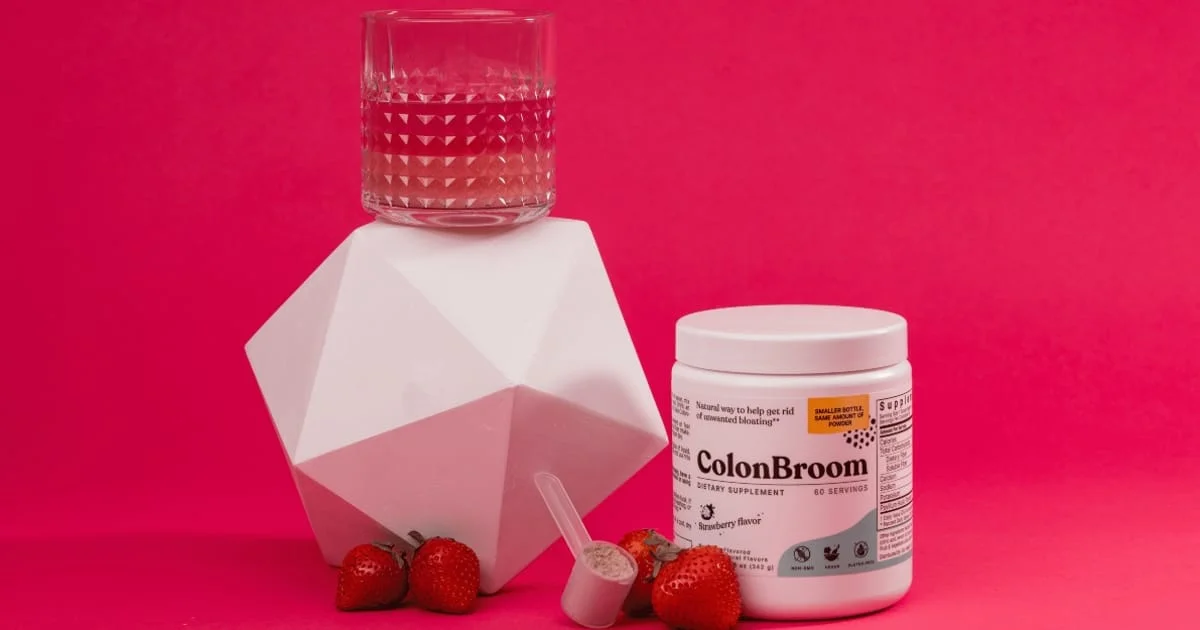
A scoop of ColonBroom and a bowl of lentils both add fiber to your day, but they get there in very different ways. This fiber supplement vs dietary fiber comparison looks at what ColonBroom’s psyllium powder actually contains, what whole food brings that a scoop does not, and where each one earns a place in your routine.
This is an independent editorial review. ColonBroom did not review or approve this article.
This article is general information, not medical advice. Talk to a doctor before starting a fiber supplement, especially if you take medication, because psyllium can affect how some medicines are absorbed. Take psyllium with plenty of water. The FDA does not approve dietary supplements before they are sold.
ColonBroom fiber supplement vs dietary fiber: the comparison table
The ColonBroom column below comes from the Supplement Facts panel and product page on the brand’s US site, checked in September 2026. The food column describes a varied, fiber-rich diet in general terms.
| What you compare | ColonBroom (one scoop) | Fiber from whole food |
|---|---|---|
| Fiber per serving | Label lists 3 grams (about 0.11 oz) of dietary fiber, 2 grams (about 0.07 oz) of it soluble | Depends on the food and the portion |
| Fiber source | Psyllium husk powder only | A mix of soluble and insoluble fibers from grains, beans, fruit and vegetables |
| What comes along | Natural flavor, stevia, citric acid, sea salt and 20 calories | Protein, vitamins, minerals, water and more calories |
| Dose control | Fixed and measured by the scoop | Changes from meal to meal |
| Cost | A separate purchase, priced by plan | Folded into the grocery bill |
| Oversight | Sold as a dietary supplement, not approved by the FDA before sale | Standard food labeling rules |
What one ColonBroom scoop delivers
ColonBroom’s Supplement Facts panel lists one scoop, about 5.7 grams (0.2 oz) of powder, as a serving, with 30 servings per container. Each scoop carries 3.6 grams (about 0.13 oz) of psyllium husk powder, which the label counts as 3 grams (about 0.11 oz) of dietary fiber. That works out to 10 percent of the Daily Value, alongside 20 calories.
The product page tells users to take two scoops a day, morning and evening, which doubles the fiber to 6 grams (about 0.21 oz). ColonBroom’s FAQ suggests easing in: one scoop mixed into 8 fl oz of water during the first week, taken 30 minutes to an hour before a main meal, then moving up to twice a day.
For scale, MedlinePlus puts the adult recommendation at 21 to 38 grams (roughly 0.7 to 1.3 oz) of fiber a day and says Americans average about 16 grams (about 0.56 oz). Even at two scoops, ColonBroom covers only a slice of that target, so meals still have to supply the bulk of it.
Fiber types: one psyllium source vs a mixed plate
ColonBroom is built around a single fiber. Psyllium is a gel-forming fiber, and ColonBroom describes it as a gentle, bulk-forming one. Food brings a spread that a single-ingredient powder cannot copy. MedlinePlus explains that soluble fiber attracts water and turns to gel during digestion, while insoluble fiber appears to speed the passage of food through the stomach and intestines.
Here is where each type shows up:
- Soluble, gel-forming fiber: oat bran, barley, nuts, seeds, beans, lentils, peas and some fruits and vegetables
- Insoluble fiber: wheat bran, whole grains and many vegetables
- ColonBroom: psyllium husk, which the label counts as two-thirds soluble fiber
A diet that leans on several of those foods gets both kinds at once. A scoop of ColonBroom gets you one kind, in a known amount.
ColonBroom as a fiber supplement for gut health vs a high fiber diet
Framed as a fiber supplement for gut health vs a high fiber diet decision, the biggest gap is everything that travels with the fiber. According to its label, a scoop of ColonBroom contains psyllium husk powder plus natural flavor, citric acid, crystallized lemon, stevia leaf extract, sea salt, fruit and vegetable juice for color, and rice hulls. A plate of beans, oats and vegetables brings protein, vitamins and minerals that no fiber powder is designed to supply.
ColonBroom markets the powder for bloating, constipation, cravings and weight management, and those are the brand’s own claims. Its site also states that those statements have not been evaluated by the FDA and that its products are not intended to diagnose, treat, cure or prevent any disease. The clinical percentages on the ColonBroom homepage come, by the brand’s own footnote, from a self-reported survey of ColonBroom Premium, a different product, and the brand says no clinical trials have been run on its other products.
Where the powder does have an edge is consistency. A scoop is the same every time, which is easier to track than a week of meals that swing from high fiber to almost none.

Cost: a fiber supplement vs fiber from food
Pricing a fiber supplement vs fiber from food is lopsided, because food fiber has no separate line on the receipt. ColonBroom, by contrast, is its own purchase. In September 2026 the brand listed a single 30-serving bottle at $69.99 as a one-time buy and at $39.99 on a monthly subscription, with lower per-bottle prices on multi-bottle plans. Prices change often, and the site was running a sale when we checked.
The dose matters for cost too. At the two scoops a day the product page recommends, one bottle lasts about 15 days rather than a month. Beans, oats and frozen vegetables deliver fiber inside meals you were going to buy anyway, which is the strongest reason to treat food as the base and a supplement as the top-up.
Rules and claims: how ColonBroom is regulated
ColonBroom is sold as a dietary supplement. The FDA does not approve dietary supplements for safety or effectiveness before they go on sale; the company is responsible for what it sells, and the agency acts after a product is on the market. Fiber that is naturally part of beans or grains counts on a Nutrition Facts label without any such question.
That does not make the powder unsafe or the food automatically better. It means the benefit claims on a supplement tub are the maker’s claims, and you should read them that way.
Using ColonBroom alongside a fiber-rich diet
If you decide to add ColonBroom, these steps keep it in a supporting role:
- Build the base with food first: beans, lentils, oats, whole grains, fruit and vegetables.
- Begin with one scoop a day in 8 fl oz of water, as ColonBroom’s FAQ suggests, before moving to two.
- Drink extra fluid through the day. MedlinePlus says to drink at least 8 ounces of liquid every time you take psyllium.
- Keep it away from your medicine. ColonBroom’s help center says to take it at least 2 hours before or after medications, and MedlinePlus names drugs to keep 3 hours away from a psyllium dose.
- Ask a doctor before starting if you are pregnant or nursing, take prescription medicine, or have a digestive condition such as IBS or diverticulitis, which ColonBroom’s own FAQ also advises.
Frequently Asked Questions
Should I pick a fiber supplement for gut health or a high fiber diet?
Choosing between a fiber supplement for gut health or a high fiber diet is rarely an either-or call. Food gives you both fiber types plus nutrients, while ColonBroom gives a fixed amount of psyllium that can fill a gap on low-fiber days.
How much psyllium is in a scoop of ColonBroom?
The Supplement Facts panel lists 3.6 grams (about 0.13 oz) of psyllium husk powder per scoop, counted as 3 grams (about 0.11 oz) of dietary fiber.
Can I take ColonBroom with my medication?
Check with your doctor or pharmacist first. Psyllium can reduce how well some medicines are absorbed, and ColonBroom itself recommends leaving at least 2 hours between a scoop and any medication.
What is ColonBroom’s return policy?
ColonBroom’s terms allow a refund within 14 days of delivery for products that are unopened and in original packaging, or that arrive faulty or not as described. For subscriptions, only the initial purchase qualifies, not later recurring shipments.
Bottom line
ColonBroom delivers a measured dose of psyllium in a flavored drink, which is useful when you want a predictable top-up. Whole food still wins on variety and nutrients, and it adds no separate bill, so treat ColonBroom as an add-on to a high-fiber plate, and talk to your doctor before adding it if you take medication.


3 Comments
Comments are closed.