
Replacing a tap is a morning. Replacing the basin it sits in is a weekend, a countertop cut and a plumber. The question bathroom faucet vs full sink replacement is usually settled before you shop at all, by three holes drilled in a deck years ago and by one measurement no storefront lets you sort on.
This is an independent editorial review. Ferguson did not review or approve this article.
The federal rule quoted below sets a ceiling on how much water a faucet may use. It says nothing about whether a faucet will fit the basin you already own, nothing about finish or durability, and nothing about who should do the work; it appears here only because it explains why one widely advertised number cannot sort this aisle.
A spec table for bathroom faucet vs full sink replacement
The two routes are not two versions of one job. They touch different parts of the installation, and they fail in different places.
| What you are deciding | Faucet only | Faucet and basin together |
|---|---|---|
| What has to match | The existing hole count and hole spacing in the deck | Nothing; you choose both halves at once |
| Where the measurement lives | Under the basin, in the deck you already own | On the cabinet run and the countertop cutout |
| Water use | Capped by federal rule, and the shelf sits well under the cap | Identical cap; the basin changes nothing |
| Parts you may still have to buy | Supply lines, sometimes a deck plate, sometimes a drain | All of the above plus a trap, and often a countertop cut |
| Reversibility | High; the old faucet can go back on | Low once the countertop is cut |
| Where the catalog helps | Deep: thousands of listings, filterable by flow and holes | Shallow: far fewer listings, no spacing filter at all |
The ceiling the law sets, and the shelf that sits a long way under it
Water use is the number faucet marketing reaches for first, and it is the one number that cannot separate two modern faucets, because it is capped. Under 10 CFR 430.32(o), the maximum water use allowed for lavatory faucets manufactured after January 1, 1994 is 2.2 gallons per minute “when measured at a flowing water pressure of 60 pounds per square inch (414 kilopascals).” The same ceiling is set for lavatory replacement aerators, so swapping the aerator does not buy you around it either.
Then look at what a large plumbing retailer actually stocks against that ceiling. Read on November 13, 2026, the bathroom sink faucet category at Ferguson listed 2,009 products and offered a flow rate filter with four values: 1.2 gpm against 1,314 listings, 0.5 gpm against 348, 1.5 gpm against 118 and 1.0 gpm against 101. Nothing on that shelf is sold at the legal maximum. The regulated ceiling describes a faucet nobody is selling.
That has a practical consequence for the comparison. If the complaint about your current basin is weak flow, a new faucet is unlikely to fix it and a new basin certainly will not, because neither one is where the restriction lives. Pressure, the supply valves and the aerator are. If the complaint is that the basin is cracked, stained or the wrong size for the cabinet, no faucet will fix that either.
The one measurement that decides it, and the filter nobody offers
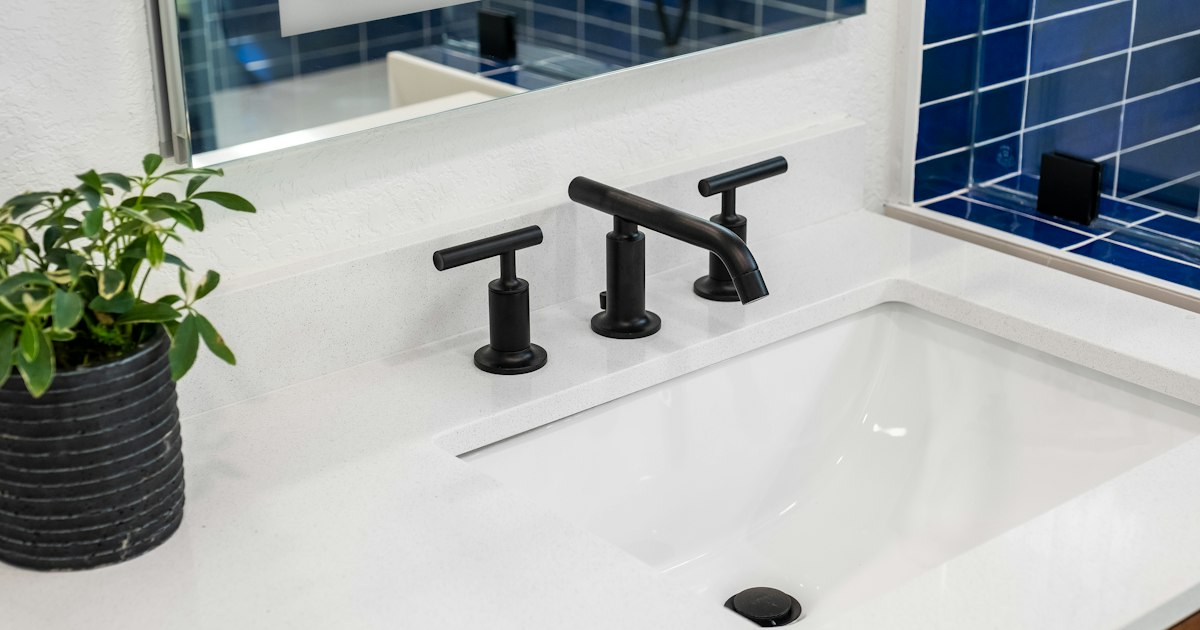
A deck-mounted faucet has to land on holes that already exist. The catalog is good at the count and silent on the spacing. On the same reading day, the faucet category at Ferguson let you filter by number of holes (1,069 listings at three holes, 858 at one, 126 at two) and by faucet mount (1,796 deck mount, 97 wall mount), and it carried no filter at all for faucet center size. The bathroom sinks category, 573 products, offered installation type, material, width, shape, ADA compliance and number of holes, and likewise no spacing filter.
Faucet center size is printed on individual product pages. Two centerset faucets read that day both printed “4 in” centers, both printed three holes, and both printed 1.2 gpm, and they still differed on spout reach, spout height, maximum deck thickness and whether a deck plate came in the box. That is the shape of the whole aisle: the variables that decide fit are on the listing, one at a time, and not in the sort.
- Count the holes in your own deck first. Three holes at four inches apart is a different purchase from three holes at eight.
- Read the “drain included” row, not the photograph. Both centerset faucets read that day included a drain; neither included supply lines, and only one included a deck plate.
- Check maximum deck thickness if your countertop is stone. The two faucets published 1-3/16 in and 1-3/8 in, which is a real difference on a thick slab.
- Look for the overflow on any basin you are considering, and for how many faucet holes it is drilled.
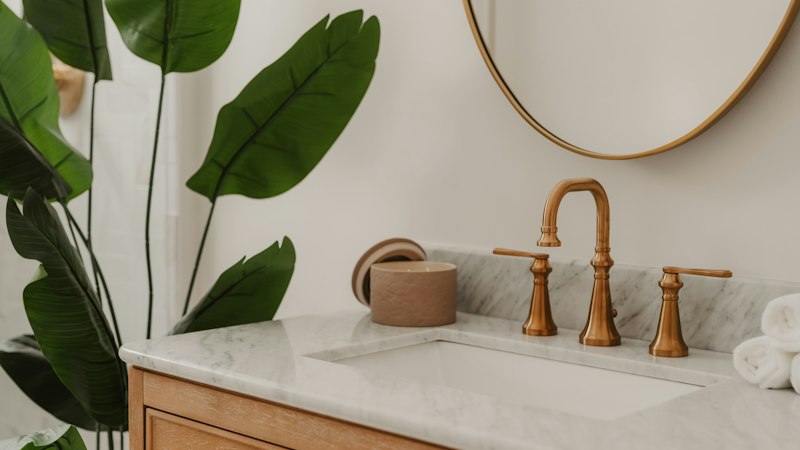
Reading bathroom faucet versus full sink replacement on one product page
The honest way to run bathroom faucet versus full sink replacement is to open one basin listing and read it as if you had already bought the faucet. One undermount oval basin listed by Ferguson printed “No Hole” in its number of holes row and stated in prose that there are no faucet holes on the sink. A basin like that does not take a deck-mounted faucet at all. It forces the faucet onto the countertop behind it or onto the wall, which turns a faucet swap into plumbing inside a wall cavity.
That listing also showed why the spec rows and the sales prose need reading separately. Its description said the drain outlet hole measures 1-1/2 inches and called it compatible with most standard lavatory drains, while its own spec table printed a drain opening of 1-3/4 in. Neither statement is dishonest and both are probably describing different parts of the same opening, but a buyer ordering a drain assembly from one of those two numbers has a coin flip rather than a measurement.
The difference between bathroom faucet and full sink replacement in the cabinet below
Stated as a plumbing job, the difference between bathroom faucet and full sink replacement is whether anything below the deck has to move. A faucet swap stays above the basin and ends at two supply connections. A basin swap touches the trap, the tailpiece, the mounting clips or the sealant bed, and on an undermount basin it touches the countertop itself, which is the part of a bathroom that cannot be undone.
- Measure the hole count and the spacing under your existing basin.
- Decide whether the complaint is about the faucet, the basin or the water supply.
- Shortlist faucets on hole count and mount, then read spout reach and deck thickness on each listing.
- If the basin has to change, confirm the installation type and the hole drilling before anything else.
- Price the small parts separately, because supply lines are rarely in the box.
Where bathroom faucet or full sink replacement for beginners usually goes wrong
The common first mistake in bathroom faucet or full sink replacement for beginners is shopping by picture. A single-hole faucet on a three-hole deck needs a deck plate, and a deck plate is a separate line item that one of the two faucets read that day included and the other did not. The second mistake is assuming the retailer’s filters describe the purchase. They describe the catalog.
Related guides
- Undermount Kitchen Sink vs Drop In Kitchen Sink
- Cabinet Hardware vs Cabinet Refacing
- Replacement Dishwasher vs Dishwasher Repair
Frequently Asked Questions
Once the hole count is known, the same four questions follow.
Ques: Will a new faucet improve weak water flow?
Rarely. Federal rule caps lavatory faucets at 2.2 gpm at 60 psi, and the shelf sits well under that already, so a replacement is usually swapping one restricted faucet for another. Supply valves, the aerator and household pressure are the places to look first.
Ques: Can I fit any faucet to my existing basin?
Only if the hole count and the spacing match. A retailer will let you filter by number of holes, but center size sits on the individual listing, so that measurement has to be read product by product.
Ques: Does a new basin come with a faucet?
Assume not. The basin listing read for this article did not say either way, and one popular undermount style ships with no faucet holes at all, which makes the faucet a separate and more constrained decision.
Ques: Which route is cheaper to reverse?
The faucet, by a wide margin. The old faucet goes back on the same holes. A countertop cut for a new basin is permanent.
You can see the current lineup on the retailer’s own category page.
Bottom line
Water use will not sort this decision, because the law already flattened it and the shelf sits under the cap. Hole count, hole spacing and whether anything below the deck has to move are what separate a morning from a weekend, and only the first of those three is something a catalog will sort for you.